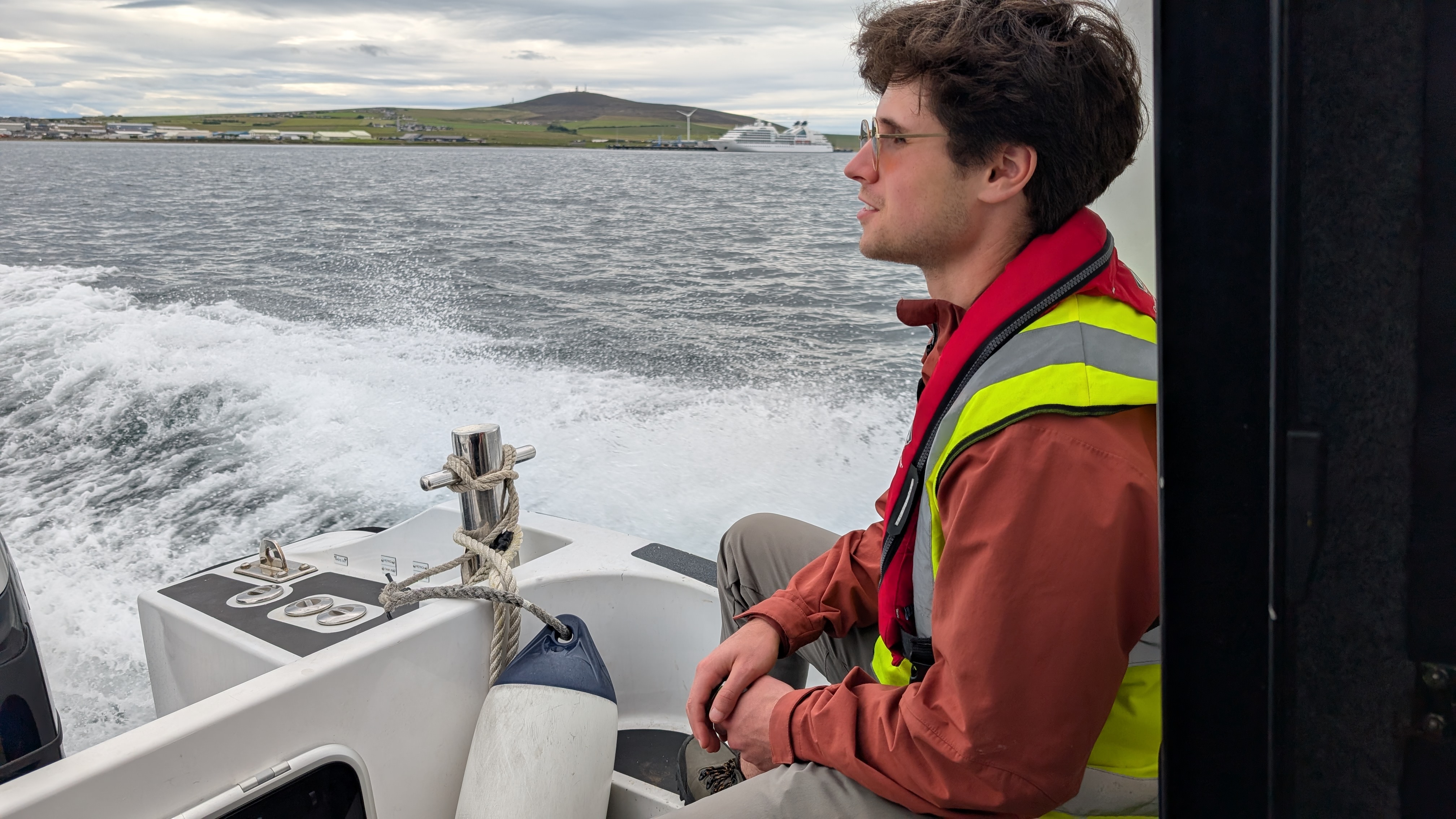
Research can seem like a long-term investment, developing skills and knowledge that may be applied at some point in the future. Rafe’s project is a prime example of how IDCORE and its’ researchers act on a much more immediate timescale. Through his EngD, Rafe is not only improving the tools used for offshore renewables project development, but he is directly using those tools with clients. He feels he is building a strong understanding of both the sector’s needs and those of the actors within it.
The cutting edge
Rafe values the feeling of working at the ‘cutting edge’ through his research. His work is of course academically novel, adding to the collective knowledge, but he also emphasises how he is pushing the boundaries of industry practice. During his placement with industrial sponsor TRIOS Renewables, he has been involved in delivering several commercial projects. This work involves modelling the operating and maintenance requirements for offshore renewable projects, and has led to Rafe utilising the very tools he’s helping improve through his research. Consequently, he has attained a first-hand understanding of how his work can answer important questions for the sector. It has also shown him how these issues integrate with the wider concerns of developers and operators in the industry.
Quote: Rafe Watson
“Developers are asking you the questions they want to know, which is kind of what I think IDCORE is about: answering the questions that industry want to know. So I try to incorporate that, to shape my research.”
Project Details
Rafe is investigating the potential for using higher resolution weather modelling to better understand O&M constraints for offshore wind projects. Organisations, such as his project sponsor, TRIOS, currently use quite low-resolution weather modelling in their Monte Carlo simulations to estimate these constraints. Rafe is trying to determine whether integrating this higher resolution data results in more accurate prediction of key performance indicators for project developers. He’s working towards demonstrating his findings through a case study, based on one of TRIOS’s partner organisations.
This work could have significant implications for the sector. There are only limited times of year where maintenance can be carried out on these wind farms due to weather-related safety issues. This work requires highly specialised ships, and contracting for these can represent up to 30% of a project’s operational costs. A better understanding of these costs could be an important enabler for project development.
Personal development
Following his chemical engineering degree, Rafe first went on to work at a 3D printing company. During his time there, he became involved in battery technology projects, sparking a further interest in the energy sector. This ultimately led to him applying for, and being accepted to, IDCORE. Such a change in sector can be challenging, but Rafe feels IDCORE gave him much greater confidence to do so, supporting him personally and through the comprehensive training the programme provides. He highlights his cohort of researchers as being an especially important part of this, easing his transition.
While not directly related, he feels that his engineering background provided him with a strong skillset upon which to build his project. In particular, he sought out a project that would allow him to further develop his highly technical coding skills. Beyond the technical, he feels that IDCORE has introduced him to a range of approaches and ideas, including political, economic and ecological considerations.
Sponsor benefits
TRIOS is a small consultancy, comprising of just 3 people at the time Rafe joined the organisation. He feels he’s become very well integrated into the team, allowing them to achieve more than they otherwise would have. The CEO of the company, David MacMillan, is also an academic, and so is well placed to supervise Rafe in making decisions that benefit both him and the company. One key benefit Rafe finds from being involved with much of the company’s commercial work is the contacts he’s forming. This exposure through TRIOS is helping him access networks which should help him throughout his planned career in the offshore renewables sector.
Cohort: