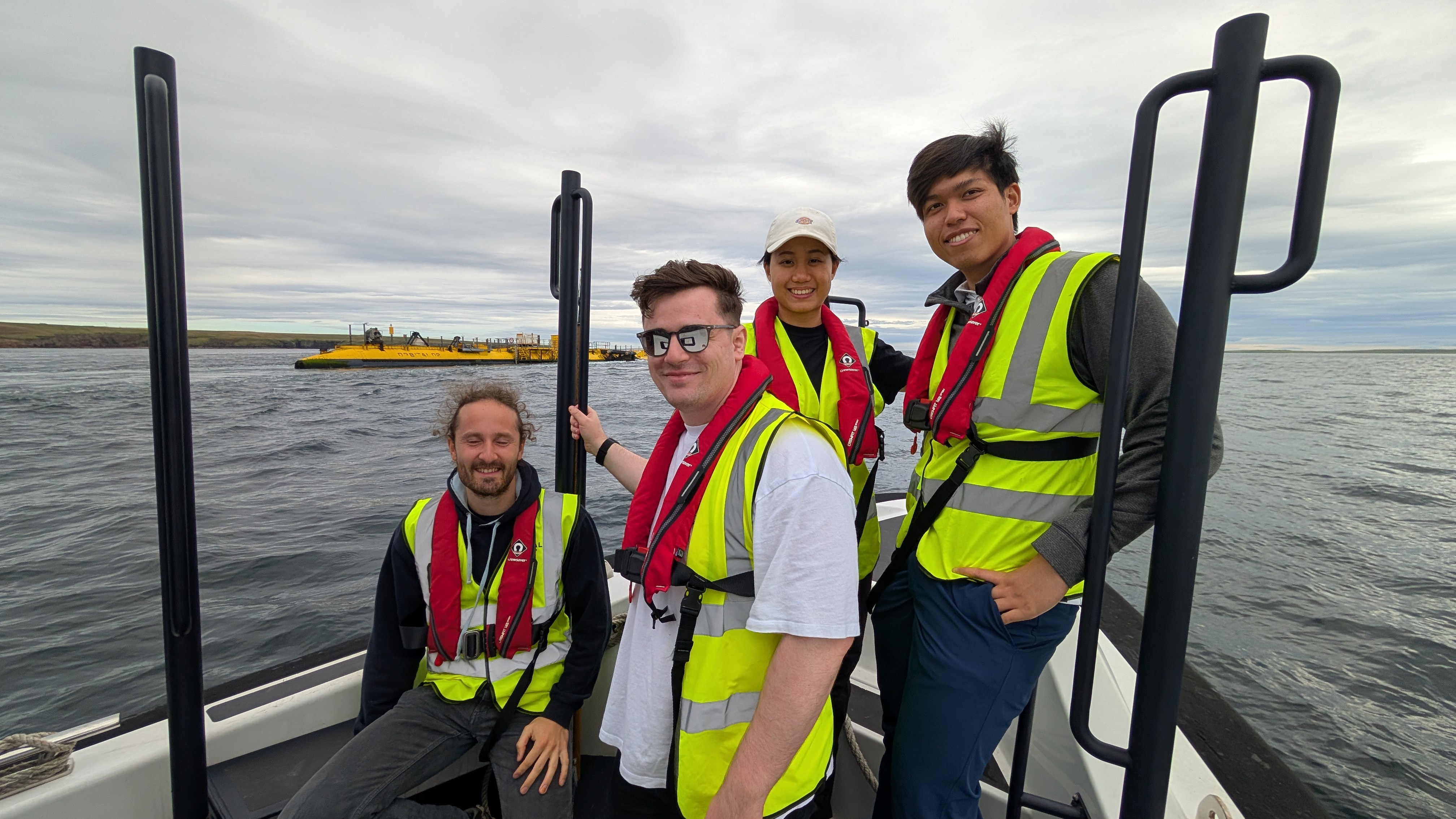
Choosing a sponsor
Liam was very keen to work with his project sponsor SSE Renewables, listing them for all three of his project choices during the selection process. The organisation appealed to him due to its large size, with the associated resources and leverage that entails. He is also proudly Scottish and valued the opportunity this would give him to help drive Scotland’s renewable energy future.
Having worked with the company for a little over a year now, Liam believes that he made the right decision working with SSE. He’s become well integrated within his team in the company, working with a mixture of more experienced staff as well as other early-career colleagues. Having a team around him has reduced the isolation of his research, something he especially values when comparing his experiences with other PhD /EngD candidates. Working at SSE has also given him a host of opportunities, with additional training provided through the company, and many chances to expand his professional network.
Alyona Naberezhnykh, Liam’s industrial supervisor and an IDCORE alumni herself, also sees SSE reaping the benefits of Liam’s involvement. She describes his project as progressing well and providing important knowledge to the organisation. Importantly, Alyona sees IDCORE research sponsorship as a cost-effective means of conducting R&D within the company. Sponsorship is relatively inexpensive, and it allows the company to utilise academic resources collaboratively, substantially reducing upfront costs.
Quote: Alyona Naberezhnykh, Metocean Engineer, SSE Renewables
“IDCORE enables SSE to tap into a collaborative research environment, drawing on the combined expertise of three universities, while supporting efficient and effective research delivery through embedding the research student within the team."
Project details
Liam’s project involves him conducting a detailed analysis of how variations in metocean conditions can affect loads on the different parts of floating offshore wind structures. It is a largely data and simulation-based project which suits Liam’s skills and capabilities well, although he is also developing his understanding of structural design engineering. Part of this work has been to use a machine learning model to help speed up the process of identifying which metocean parameters are most relevant to his simulation.
This research should, in the long run, help to improve structural design and ultimately reduce costs as engineers can be less over-cautious in their construction of these floating units. This end goal is highly valued in the sector as cost reductions are increasingly becoming a priority. However, Liam believes that the smaller problems he is tackling ‘along the way’ in his research are proving just as valuable as this ultimate goal. This is especially true of his work optimising and running digital models, which could have multiple transferable applications across the company.
Building on strong foundations
Liam has a strong background in data science, beginning with his undergraduate degree in physics. After graduating and working for a time with the NHS, Liam returned to study his masters in sustainable energy, wanting to gain more vocational skills. Following this, he worked in data analysis at Research Data Scotland (RDS), where helping researchers connect with data was a key part of his role. Liam’s IDCORE project is allowing him to build upon these experiences and knowledge alongside developing new skills through the broad training he’s receiving.
The first year of training in the centre was a highlight for Liam, both in terms of its content but also due to IDCORE’s cohort learning model. He felt this really taught him how to work with others, often with very different skillsets, under time constrained conditions. This helped him transition into his work with SSE, where he regularly has to communicate his work to a variety of people from different backgrounds.
Liam will be putting these communication skills to further use as he prepares to publish his first paper and present it at a conference. Presentation and public speaking are key skills he’s looking to develop, and he is grateful that IDCORE place such an emphasis on them in their training. He has experienced how important these competencies are in industry and so is keen to make the most of the opportunity, as well as looking forward to seeing his name at the top of a paper.
Quote: Liam McAlister
“The good thing about IDCORE is you have to do a lot of presentations. As an engineer in industry you have to be able to present your ideas properly, if you’ve got a project and you’re presenting your results then that’s a very important thing to be able to do well. This is especially true when there are people in the audience who might not have the same technical background as you.”
Cohort: